Best AI Courses to Study Abroad in 2026: Top Universities, Countries and Career Paths
You have probably noticed something over the past two years. Every industry conversation, every job listing, every university brochure circles back to the same subject: Artificial Intelligence. Choosing the best AI courses to study abroad in 2026 is no longer a niche decision made by a small group of tech enthusiasts. It is one of the most strategic academic choices any international student can make right now. More students than ever are actively searching for the best AI courses to study abroad in 2026 and the competition for seats at top programs is growing fast.
Countries including the US, UK, Canada, Germany, and Australia are all reporting a serious shortage of qualified AI professionals. Universities are expanding programs at a pace not seen in any other discipline. Employers are competing for graduates before they even finish their final semester. And starting salaries in AI are already among the highest of any field globally.
This complete guide covers everything about the best AI courses to study abroad in 2026, which countries lead in research and career outcomes, which universities rank highest according to QS 2026, what careers you can realistically build, and what you need to do right now to put together a competitive application.
If you are still deciding which country to study in, you can explore top AI universities in Germany as one of the most affordable and highly ranked destinations for international students in 2026.

Why the Best AI Courses to Study Abroad in 2026 Are Worth the Investment
Searching for the best AI courses to study abroad in 2026 is one of the most important decisions you will make for your career. Studying AI abroad is not just about getting a degree. It is about placing yourself inside the research ecosystems, industry networks, and startup cultures where AI is actually being built. Graduates who combine an AI degree with international study experience consistently see a 15 percent average salary increase compared to peers who studied only domestically. That gap reflects something employers are increasingly clear about: global experience in AI education builds the kind of cross-cultural collaboration and adaptability that international AI teams genuinely need.
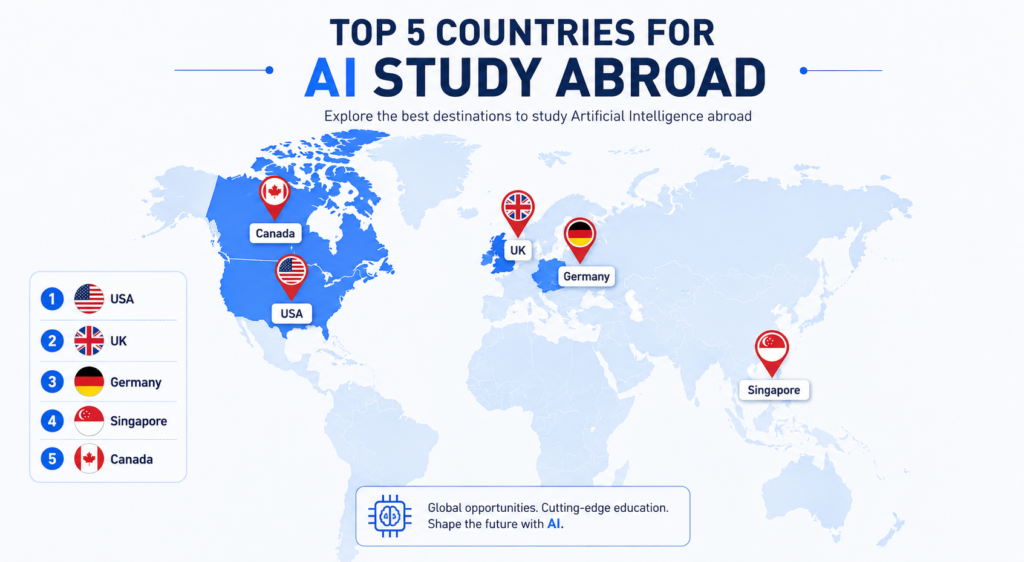
According to research on international AI education outcomes, as of 2026, STEM graduates from top international programs earn starting salaries 40 to 80 percent higher than domestic graduates. The best AI and computer science programs are concentrated in the US, UK, Canada, Germany, and Singapore. The connections you build during your program, with professors, research labs, and industry partners, often matter as much as the qualification itself.
💡 Worth knowing: The OECD AI Policy Observatory tracks AI investment, talent demand, and research output by country in real time. It is one of the most reliable resources for understanding where AI careers are growing fastest before you commit to a destination.
What Do the Best AI Courses to Study Abroad in 2026 Actually Cover
Before searching for the best AI courses to study abroad in 2026, it helps to understand what these programs actually teach. AI degrees at leading international universities are not one-size-fits-all. It is quite common for AI to be combined with another subject, for example computer science, mathematics, or robotics. This means the curriculum and modules vary considerably between institutions, and you should look closely at each program before applying.
Core topics covered across most programs in 2026 include machine learning, deep learning, natural language processing, computer vision, robotics, data science, algorithm design, and AI ethics. Many universities now dedicate entire modules to responsible AI development. This reflects growing regulatory pressure from governments in Europe, the US, and Asia following the introduction of the EU AI Act in 2024.
Specialization tracks students most commonly choose in 2026 include AI in healthcare, AI in finance, autonomous systems, large language models, human-computer interaction, and AI policy and governance. Choosing the right specialization early sharpens your career pathway and makes your application to competitive programs considerably stronger.
Top Countries Offering the Best AI Courses to Study Abroad in 2026
United States: Still the Global Leader
The US remains the top destination for international students searching for the best AI courses to study abroad in 2026. Universities like MIT, Stanford, and Carnegie Mellon are world leaders in deep learning, robotics, and computer vision. Silicon Valley’s startup culture and proximity to the world’s leading technology companies give US AI students access to internship and employment pipelines that are simply unmatched anywhere else.
International students in the US benefit from STEM visa extensions that allow up to 36 months of post-graduation work in artificial intelligence fields. This makes the US one of the most practical long-term destinations for students who want to build careers in the country after finishing their degree.
United Kingdom: Research Excellence and Career Pathways
The UK is among the top places to pursue the best AI courses to study abroad in 2026, with institutions including Oxford, Cambridge, UCL, and Imperial College London. The UK AI sector is valued at more than £21 billion and growing rapidly. International students also benefit from the Graduate Route visa, which allows them to remain and work in the UK for two years after graduation, or three years for PhD graduates.
Germany: World Class Education at Low Cost
Germany is the most underrated destination for international students searching for the best AI courses to study abroad in 2026. Public universities in Germany charge zero tuition. Students pay only a semester contribution of approximately 250 to 400 euros per semester, which covers administrative fees, student union charges, and local public transport. Germany’s national investment of 3 billion euros in AI research means universities like TU Munich and LMU Munich are operating at the cutting edge of applied AI, particularly in manufacturing, automotive, and engineering sectors.
To explore specific universities and their AI programs in Germany, visit our Germany universities page for a full breakdown of options available to international students in 2026.
Singapore: Asia’s Premier AI Hub
In the latest QS subject rankings, NUS School of Computing is placed 3rd globally in Data Science and Artificial Intelligence. Singapore’s position as a regional technology hub means AI graduates have access to careers not just within Singapore but across the broader Southeast Asian technology market, one of the fastest growing in the world. Government investment in AI research and strong industry partnerships make Singapore a compelling and increasingly popular destination for international students.
Canada: Research Depth and Flexible Post-Study Pathways
Canada’s cities of Toronto, Montreal, and Vancouver are globally recognized AI hubs. The Vector Institute in Toronto and MILA in Montreal are two of the world’s most respected AI research organizations, and both maintain close ties with University of Toronto and McGill University respectively. Canada’s post-graduation work permit pathway gives international graduates significant flexibility to build careers in the country after finishing their studies.
Top Universities for AI in 2026 According to QS Rankings
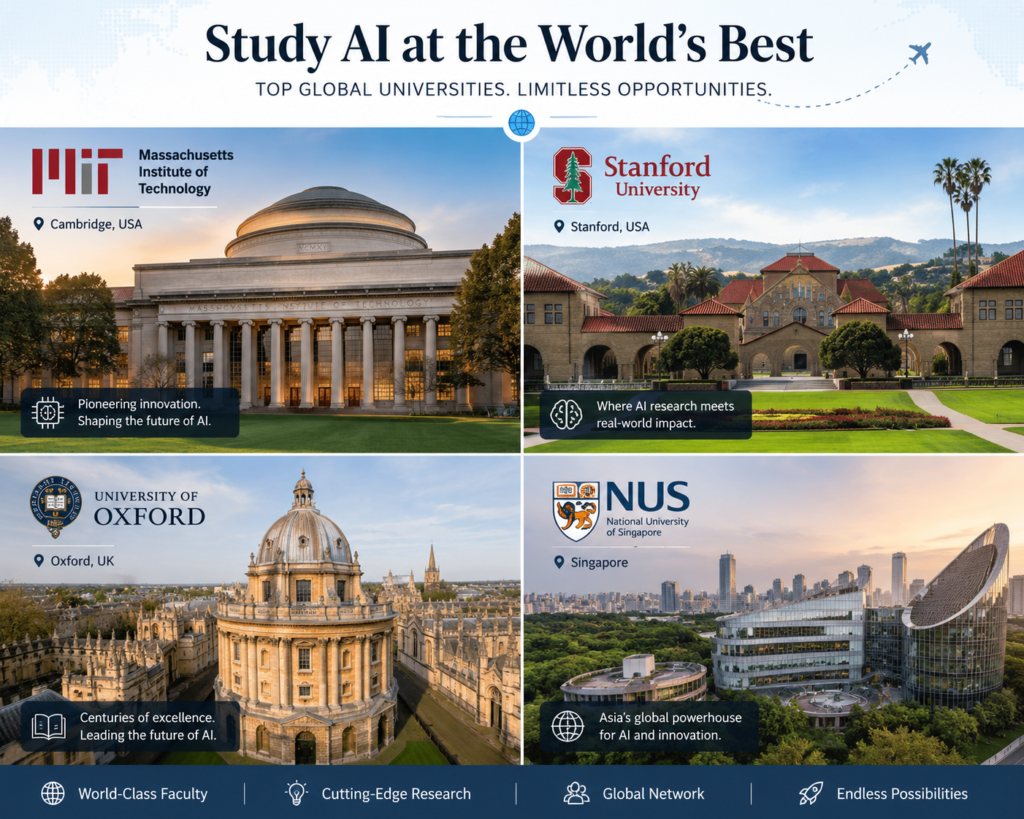
According to the QS World University Rankings for Data Science and Artificial Intelligence 2026, more than 200 of the world’s best universities have been evaluated. Massachusetts Institute of Technology holds first place. The US, UK, Singapore, and mainland China are all represented in the top 10. Here are the universities consistently appearing at the top across major rankings in 2026:
1. Massachusetts Institute of Technology (MIT), USA — Best for AI Research
Ranked number one globally for Data Science and Artificial Intelligence by QS 2026. MIT’s Computer Science and AI Laboratory is the world’s most cited research facility in machine learning, robotics, and computer vision. Students have direct access to faculty working on some of the most consequential AI research being conducted anywhere.
2. Stanford University, USA
Located in Silicon Valley, Stanford’s AI Lab and interdisciplinary programs provide unmatched access to tech industry partners. Stanford’s approach uniquely fuses AI with cognitive science and ethics, preparing students for the complex, evolving challenges that define AI work in 2026.
3. Carnegie Mellon University, USA
A historic leader in AI with a dedicated School of Computer Science and Robotics Institute. CMU excels in autonomous systems, human-AI interaction, and machine learning theory. Its industry connections with Google, Apple, and major defense organizations give students a strong pipeline into high-demand roles.
4. University of Oxford, UK
Oxford tops the Times Higher Education Computer Science rankings in 2026. Programs blend deep technical expertise with philosophical and ethical considerations that are increasingly valued by employers navigating AI regulation and public trust challenges.
5. National University of Singapore, Singapore
NUS School of Computing holds 3rd place globally in Data Science and Artificial Intelligence in the latest QS rankings. NUS focuses on efficient AI systems and large-scale deployment across industry. Strong government and corporate partnerships provide students with excellent applied research and employment opportunities.
6. ETH Zurich, Switzerland
One of Europe’s strongest technical universities, ETH Zurich combines robotics and computer vision with deep engineering expertise. It is a strong choice for students interested in applied AI research in the European context, particularly in manufacturing, healthcare, and autonomous systems.
7. University of Toronto, Canada
Home to the Vector Institute and the work of deep learning pioneer Geoffrey Hinton, the University of Toronto is Canada’s most prominent AI research university. Strong connections to Toronto’s growing tech industry give students access to one of North America’s fastest-growing AI employment markets.
8. University of Edinburgh, UK
Edinburgh’s Artificial Intelligence MSc is one of the most respected programs in Europe. The university’s research spans natural language processing, machine learning, and computer vision, with strong connections to Scotland’s emerging technology sector.
AI Specializations With the Strongest Career Demand in 2026
Not all AI specializations carry equal weight in the 2026 job market. Choosing the right track significantly affects both your employment options and starting salary.
Machine Learning Engineering
When evaluating AI courses abroad in 2026, machine learning engineering consistently ranks as the most in-demand specialization globally. Machine learning engineers build the predictive models and systems powering products across healthcare diagnostics, financial risk modeling, e-commerce recommendations, and logistics optimization. Strong Python, TensorFlow, and PyTorch skills are essential for this track.
Natural Language Processing
Students who want rapid employment after graduating should strongly consider NLP. Explosive demand since large language models became mainstream. Students specializing in NLP work on conversational AI, real-time translation, content generation, and enterprise search systems. This is one of the most commercially active areas of AI research in 2026.
Computer Vision
Powers autonomous vehicles, medical imaging analysis, manufacturing quality control, and facial recognition systems. Particularly strong demand in Germany’s automotive and manufacturing sectors, Japan’s robotics industry, and US defense and logistics markets.
AI Ethics and Responsible AI
An emerging specialization with rapidly growing demand as the EU AI Act and equivalent regulations in the US and Asia create entirely new categories of professional roles. AI ethics consultants, compliance officers, and policy advisors are now being recruited by governments, NGOs, and major corporations worldwide.
Robotics and Autonomous Systems
Combines AI with physical engineering and is particularly strong at universities like CMU, ETH Zurich, and TU Munich. Strong demand from healthcare robotics, industrial automation, space exploration, and defense sectors.
Career Paths and Salaries After Studying the Best AI Courses Abroad in 2026
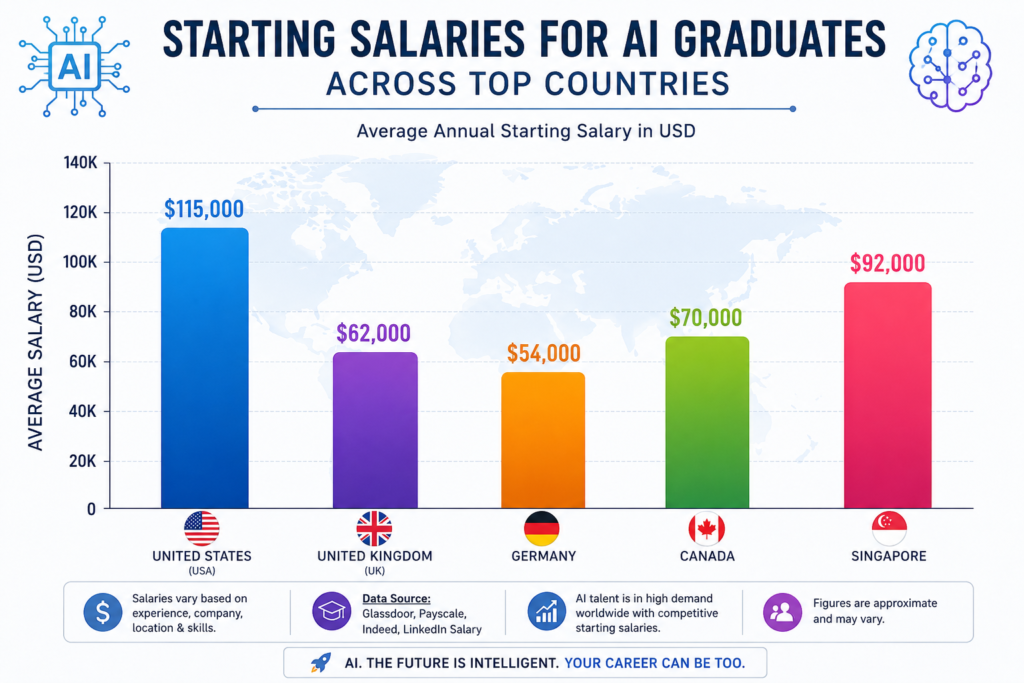
One of the biggest motivators for choosing the best AI courses to study abroad in 2026 is the salary advantage that international graduates consistently demonstrate. AI professionals with international degrees command significantly higher salaries globally. The average AI engineer with a master’s from a top international university earns 40 to 60 percent more than domestic graduates. Here is a realistic overview of what graduates can expect across major destinations:
- United States: Entry-level AI graduates earn between $85,000 and $115,000 annually. Senior roles in San Francisco and New York regularly exceed $180,000.
- United Kingdom: AI Research Scientists earn an average of £78,000 annually. London, Manchester, and Edinburgh are the primary employment centers.
- Germany: AI Research Scientists earn an average of €75,000 annually. The manufacturing and automotive sectors are the largest employers.
- The Netherlands: Machine Learning Engineers earn an average of €70,000 annually. Amsterdam’s tech sector is growing rapidly.
- Canada: Entry-level AI roles in Toronto and Vancouver start between $90,000 and $120,000 CAD annually.
Common job roles AI graduates enter include Machine Learning Engineer, Data Scientist, AI Research Scientist, Computer Vision Engineer, NLP Engineer, AI Product Manager, Robotics Engineer, and AI Ethics Consultant. The career pathways available to AI graduates in 2026 are broader than in almost any other discipline.

Scholarships for International Students Pursuing AI Courses Abroad in 2026
Funding is available for international students at every level of AI study abroad in 2026. These are the most reliable starting points for scholarship research in 2026:
- Fulbright Program (USA): Fully funded scholarships for international students pursuing graduate study in the US, including AI and computer science programs.
- Chevening Scholarships (UK): Fully funded by the UK government for outstanding students from eligible countries applying to one-year master’s programs at UK universities.
- DAAD Scholarships (Germany): The German Academic Exchange Service funds international students at all academic levels. AI and engineering students are among the most commonly supported. Read more at the official DAAD website.
- Singapore Government Scholarships: NUS and NTU both offer merit-based funding for international students in AI and data science programs.
- Industry Fellowships: Google, Microsoft, DeepMind, and NVIDIA all offer research fellowships for master’s and PhD students at partner universities. These often include stipends, internship placements, and full-time job pathways upon completion.
For a broader overview of scholarship options available to international students, explore the Dream Admit Store for complete study abroad application resources built for international students in 2026.
How to Apply for the Best AI Courses to Study Abroad in 2026: Step by Step
The application process for competitive AI programs is more demanding than standard degree applications. Here is what you need to prepare well in advance:
Academic Requirements
Most master’s programs require a strong undergraduate degree in computer science, mathematics, statistics, or engineering. Some programs accept applicants from other quantitative fields if they demonstrate relevant programming and mathematics coursework. A minimum GPA of 3.5 or equivalent is expected at most top 10 programs.
English Language Test Scores
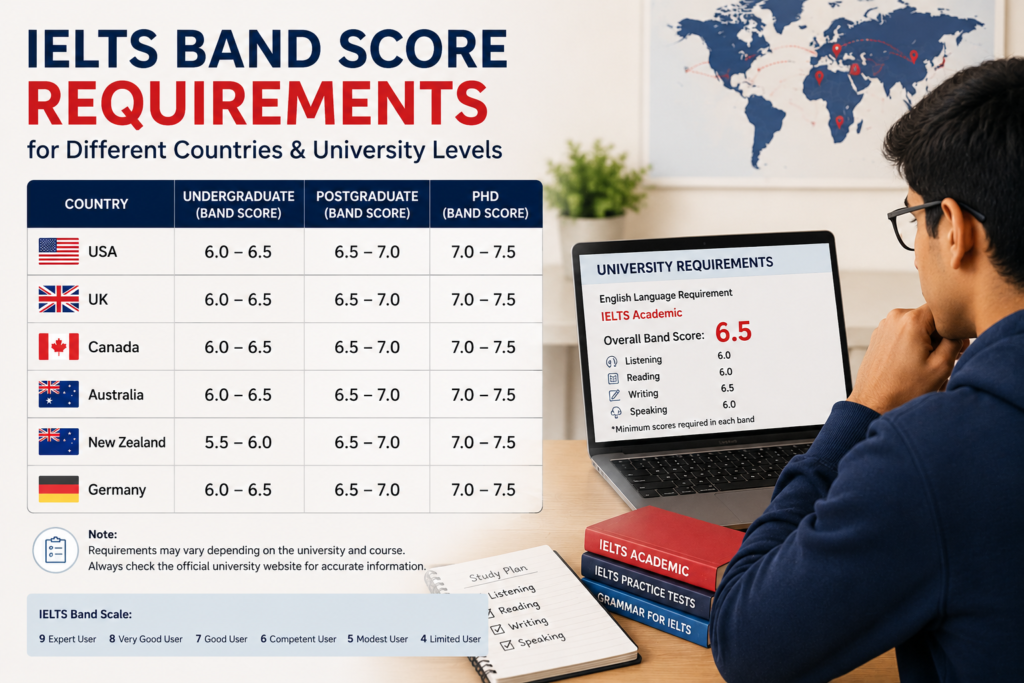
IELTS or TOEFL scores are required for all non-native English speakers. Most top AI programs require an IELTS score of at least 7.0 overall, with no section below 6.5. Begin your language test preparation well in advance of your application deadline.
Statement of Purpose
Your SOP must clearly connect your academic background to specific AI research interests, name faculty members whose work aligns with yours, and explain why this particular program fits your career goals. Generic SOPs do not survive review at competitive AI programs. Students applying for the best AI courses to study abroad in 2026 need a particularly strong SOP. Our essay help service has helped hundreds of students craft SOPs that get noticed by AI admissions committees.
Research Experience
Demonstrated research experience through undergraduate projects, published papers, or research internships significantly strengthens applications to top programs. Even one well-documented undergraduate research project with a named supervisor makes a meaningful difference to your profile.
Application Timeline
US programs typically have December to January deadlines for September entry. UK programs accept applications from September through January. German programs often have May to July deadlines for winter semester entry. Begin your preparation at least 12 months before your intended start date to give yourself adequate time for test preparation, SOP drafting, and scholarship applications.

Frequently Asked Questions: Best AI Courses to Study Abroad 2026
The US leads globally for AI research and career opportunities. Germany is the best value option with tuition-free public universities and strong industry demand. Singapore is the top choice in Asia with government investment and strong regional career pathways. The right choice depends on your budget, career goals, and preferred industry sector.
Yes. The global AI talent shortage means demand for qualified graduates significantly exceeds supply across most markets. Graduates consistently report strong employment outcomes and above-average starting salaries within six months of completing top programs.
Most master’s programs require a background in computer science, mathematics, statistics, or engineering. Strong applicants from physics, economics, or other quantitative fields are also considered if they demonstrate relevant programming and mathematical ability
Most taught master’s programs take one year in the UK and two years in the US. Research-focused programs and PhD pathways vary by institution and funding arrangement.
Yes in most destinations. The US allows part-time on-campus work and full-time work during summer breaks. The UK allows up to 20 hours per week during term time. Germany allows up to 120 full days or 240 half days per year. Always verify current work rights for your specific visa category before accepting any employment.
Most top AI programs require an overall IELTS score of 7.0 or above, with no individual section falling below 6.5. Some programs at highly competitive universities require 7.5 overall. Always check the specific language requirements for each program you are applying to.
Final Thoughts on the Best AI Courses to Study Abroad in 2026
The demand for AI professionals is not a temporary trend driven by media hype. It is a structural shift in how every major industry operates, recruits, and grows. AI is already reshaping healthcare, finance, manufacturing, and many other sectors, and the need for skilled professionals is rising just as quickly as the technology itself.
Choosing to study the best AI courses to study abroad in 2026 puts you at the center of that shift. You gain an internationally recognized qualification, access to research and industry networks that exist nowhere else, and career options that are genuinely future-proof in a way that few other fields can claim.
The universities are world class. The scholarship opportunities are real and accessible. The salaries at graduation are among the highest of any discipline worldwide. And the only question remaining is which program is the right fit for where you want to go.
Start your research early, build your application carefully, and reach out to our essay help service when you are ready to write the SOP that gets you in.
Students who choose to study AI abroad are not just getting a degree. They are positioning themselves at the center of the most important technological shift of our generation. The future of AI is being built right now. Go be part of it.
Disclaimer: University rankings, tuition fees, visa conditions, and salary data are subject to change. Always verify current information directly with your target institution and the official immigration authority of your chosen country. For official AI policy and country-level data, refer to the OECD AI Policy Observatory.