IELTS Preparation 2026: Top 10 Strategies to Achieve Your Target Band Score
You have decided to study abroad. Your university shortlist is ready. Your application timeline is set. Then one requirement appears on almost every university’s admissions page that demands your full attention before anything else: IELTS preparation 2026.
The International English Language Testing System is accepted by more than 12,000 organizations worldwide and is a mandatory requirement for university admissions in the UK, Canada, Australia, USA, Germany, and most other major study abroad destinations. Getting your target band score is not about luck. It is about preparation, strategy, and understanding exactly what examiners are looking for in each section.
This complete IELTS preparation 2026 guide covers everything the exam format, section by section strategies, free resources, common mistakes, and a practical study plan to help you reach your target band score with confidence.
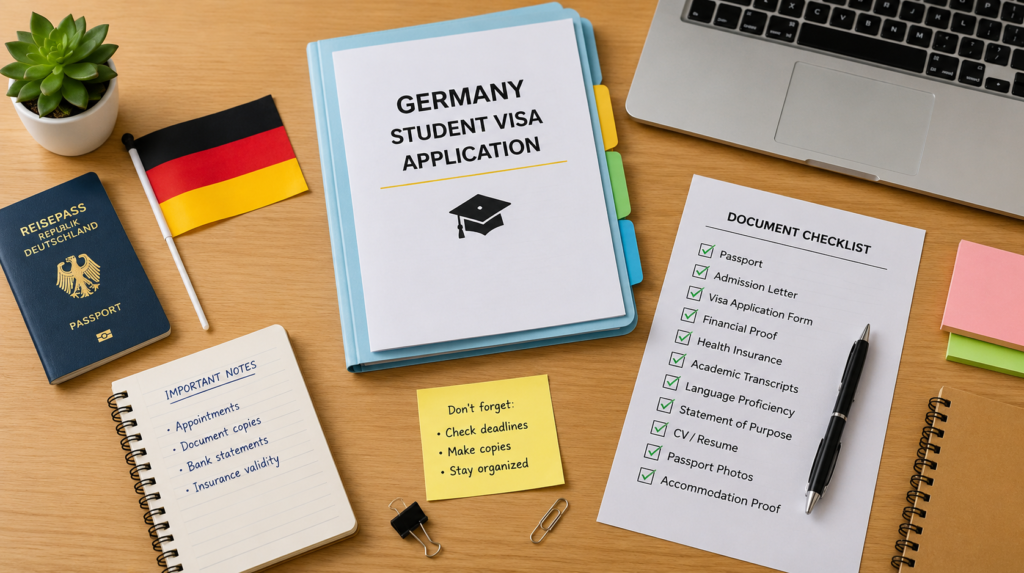
If you are still deciding which universities to apply to after your IELTS, explore top universities in Germany as one of the most popular and affordable study destinations for 2026 international students.
What is IELTS and Which Version Do You Need in 2026
Before starting your IELTS preparation 2026, you must understand which version of the test applies to your situation. There are two versions and choosing the wrong one can disqualify your application entirely.
IELTS Academic is the version required for undergraduate and postgraduate university admissions worldwide. If you are applying to a degree program at any university, this is the test you must sit. The General Training version is not accepted for university degree-level programs in most countries.
IELTS General Training is designed for migration purposes, skilled worker programs, and some secondary education pathways. It is not the version for university applications.
Both versions test the same four skills: Listening, Reading, Writing, and Speaking. The total test duration is approximately 2 hours and 45 minutes. Listening, Reading, and Writing are completed on the same day with no breaks. Speaking may be scheduled on the same day or a different day depending on your test center.
IELTS Band Score Requirements for Universities in 2026
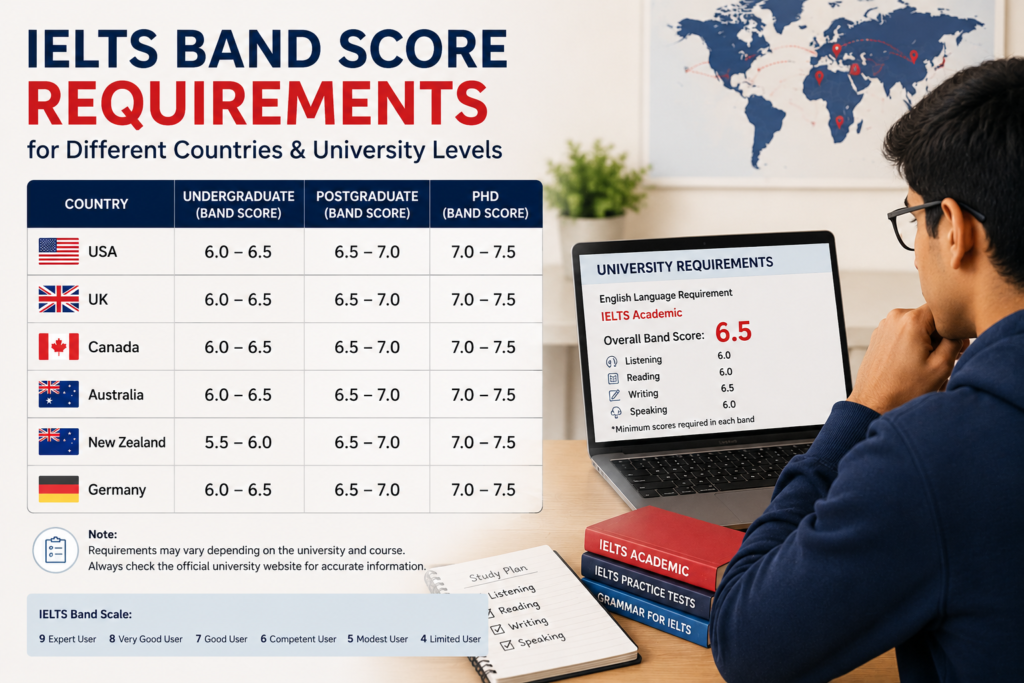
One of the first steps in your IELTS preparation 2026 is knowing exactly which band score you need. There is no universal pass or fail in IELTS. Every university and program sets its own requirements.
Here is a general overview of what most universities expect in 2026:
- Undergraduate programs: Most universities require an overall band of 6.0 to 6.5, with no individual skill falling below 5.5 or 6.0
- Postgraduate programs: Most universities prefer 6.5 to 7.0 overall, with at least 6.0 in each skill
- Competitive programs (Law, Medicine, Business): Often require 7.0 to 7.5 or higher
- Top UK universities (Russell Group): Generally require 6.5 to 7.5 overall, with Oxford and Cambridge typically demanding a minimum of 7.5
A difference of just 0.5 bands can be the difference between acceptance and rejection at many universities. This is why targeted, strategic IELTS preparation 2026 matters so much. Improving your weakest skill by even half a band raises your overall score significantly.
💡 Important tip: Always verify the exact IELTS score requirement for each specific program you are applying to. Requirements vary not just by university but by department and degree level within the same institution.
IELTS Preparation 2026: Top 10 Strategies That Actually Work
These ten strategies are built around what IELTS examiners actually look for in 2026 and the most effective ways to improve your band score in each section.
Strategy 1: Take a Diagnostic Test Before You Start
Before spending a single hour on study materials, take a full-length official IELTS practice test under timed conditions. This gives you a realistic baseline score, shows you exactly which sections need the most work, and prevents you from spending weeks improving skills that are already strong while neglecting the areas that will most impact your final band score.
Focus your preparation on your weakest skill first. A 0.5 band improvement in your lowest scoring section raises your overall band more than the same improvement in your strongest area. The official IELTS official preparation resources include free sample tests and progress checks that are the best starting point for any test taker.
Strategy 2: Understand the Band Descriptors
Most students prepare for IELTS without ever reading what examiners actually use to grade them. The IELTS 9-band descriptors are publicly available and define exactly what separates a Band 6 from a Band 7 in Writing and Speaking. Understanding these descriptors tells you precisely what to work on. In Writing, the difference between a Band 6 and Band 7 is coherence, vocabulary range, and grammatical accuracy not word count. In Speaking, the criteria are fluency, lexical resource, grammatical range, and pronunciation.
Strategy 3: Use Official Cambridge Practice Materials
Not all IELTS practice materials are equal. Cambridge IELTS Practice Tests (Volumes 18 to 20) are consistently recommended by certified IELTS examiners as the gold standard for 2026 preparation. These books contain real past exam questions, accurate timing, and the exact question types you will encounter on test day. Generic practice materials available online often use different question styles that do not reflect the actual exam format.
Strategy 4: Master Time Management Section by Section
Time pressure is one of the most common reasons students underperform in IELTS, even when their English skills are strong. Each section has strict time limits and running out of time costs band points that have nothing to do with your actual language ability.
For the Reading section, practice completing each passage in 20 minutes. For Writing, spend 3 minutes planning before you write Task 2 this investment consistently produces better-structured essays and higher scores. For Listening, practice writing answers as you hear them without stopping to think, since the recording does not replay.
Strategy 5: Write One Essay Every Day During Preparation
Writing is consistently the lowest-scoring section globally for IELTS test takers. The most effective way to improve is to write at least one essay or task every single day during your preparation period. Writing Task 2 carries more weight than Task 1 in your final Writing band score, so prioritize it. After writing, compare your essay against the official band descriptors and identify specific areas where you lost points task response, coherence, vocabulary, or grammar.
The most common Writing mistakes in 2026 that cost students band points are partial task coverage, overuse of memorized essay templates that examiners are trained to identify, and using complex vocabulary incorrectly. Write naturally and precisely rather than impressively.
Strategy 6: Train Your Ear for Different English Accents
The IELTS Listening section features a variety of native English accents including British, Australian, American, and others. Students who have only practiced with one accent typically American English from online content consistently struggle with Part 3 group discussions where overlapping speech and varied accents make answers harder to catch.
During your preparation, deliberately expose yourself to different accents through podcasts, documentaries, BBC radio, and Australian news programs. Do not use general listening exercises use official IELTS recordings that reflect the actual accent mix in the exam.
Strategy 7: Read Widely and Read Every Day
The IELTS Academic Reading section uses texts from academic books, journals, and magazines. Students who read exclusively in their first language or who limit English reading to social media consistently find this section challenging. During your preparation, read English language newspapers, academic articles, scientific magazines, and long-form journalism every day.
Focus on building reading speed alongside comprehension. The Reading section is time-sensitive and the passages are long. Practice skimming for main ideas before reading for detail. Note new vocabulary and practice using each word in a sentence passive recognition of words is not enough for the Lexical Resource assessment in IELTS.
Strategy 8: Record Your Speaking Practice and Review It
Speaking is the section that most students underestimate during IELTS preparation 2026. The examiner assesses four criteria equally: fluency and coherence, lexical resource, grammatical range and accuracy, and pronunciation. Importantly, fluency matters more than a perfect accent examiners are not looking for a British or American accent. They are assessing whether your speech is clear, natural, and easy to follow.
Record yourself answering Part 1, Part 2, and Part 3 questions under timed conditions. Play back the recording and listen for long pauses, repeated vocabulary, grammatical errors, and unclear pronunciation. Comparing your recordings to model Band 7 and Band 8 responses is one of the most effective self-improvement tools available. Do not worry about correcting small mistakes mid-sentence during the actual exam losing your train of thought costs more band points than a small grammatical error.
Strategy 9: Simulate Real Exam Conditions at Least Twice a Week
Untimed study builds knowledge. Timed practice builds exam readiness. These are not the same thing, and treating them as the same is one of the most common preparation mistakes students make. Practice under genuine exam conditions no phone, no breaks, no pausing recordings at least twice per week throughout your preparation period.
After each timed practice session, review every answer carefully. For Listening and Reading, identify why you got each wrong answer. Was it a vocabulary gap? A question type you misunderstood? A timing issue? Understanding why something went wrong is the only way to prevent repeating the same error on test day.
Strategy 10: Build Vocabulary Systematically, Not Randomly
One of the most effective and most overlooked elements of your 2026 study plan is systematic vocabulary development. The most commonly tested themes in IELTS Writing Task 2 in 2026 are technology, environment, and education. Building topic-specific vocabulary in these areas directly improves your Lexical Resource score in both Writing and Speaking.
Do not memorize word lists. Instead, learn words in context read an article about climate policy, note the specific vocabulary used to discuss cause and effect, and then use those words in your own writing the same day. Active use of new vocabulary in your own sentences builds the genuine range that examiners look for.
Free Resources for IELTS Preparation 2026
You do not need to spend a large amount of money to prepare effectively for IELTS. These are the best free resources available for IELTS preparation 2026:
- IELTS.org Official Website: Free sample tests, preparation resources, and writing task guidance published directly by the test makers. This is always the most accurate and up-to-date source available.
- British Council IELTS Preparation: Free practice tests and expert feedback resources available at British Council IELTS Preparation covering all four sections.
- Cambridge IELTS Practice Books: Volumes 18 to 20 contain genuine past exam papers and are the most reliable paid resource. Earlier volumes are available in libraries and are still highly useful for practice.
- YouTube Channels: IELTS Liz, E2 IELTS, and the official British Council IELTS channel offer free lesson videos covering every question type and examiner expectation.
- IDP IELTS App: Free mobile app with practice tests, progress tracking, and section-specific exercises for on-the-go preparation.
For students who also need help with university application essays alongside their IELTS preparation, our essay help service provides expert guidance for international students at every stage of the application process.
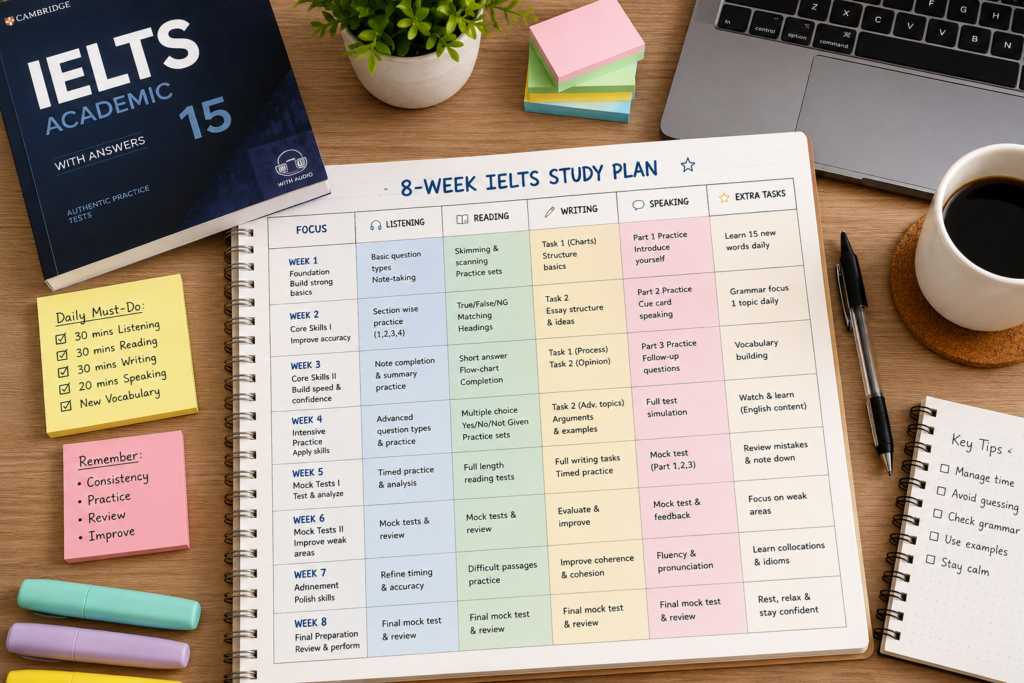
IELTS Preparation 2026 Study Plan: 8 Weeks to Your Target Score
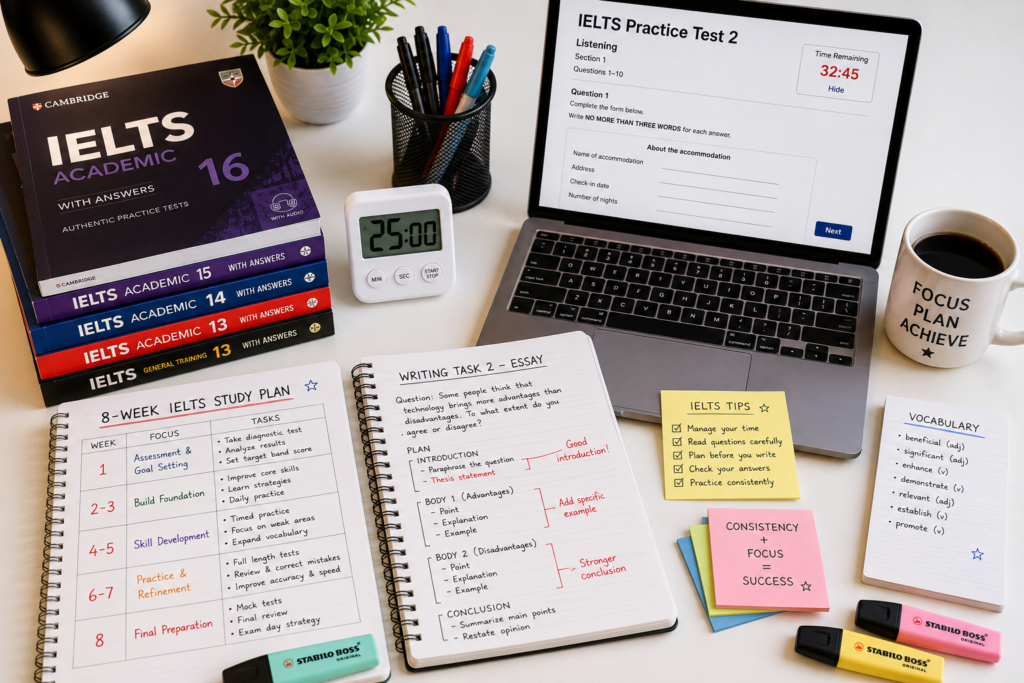
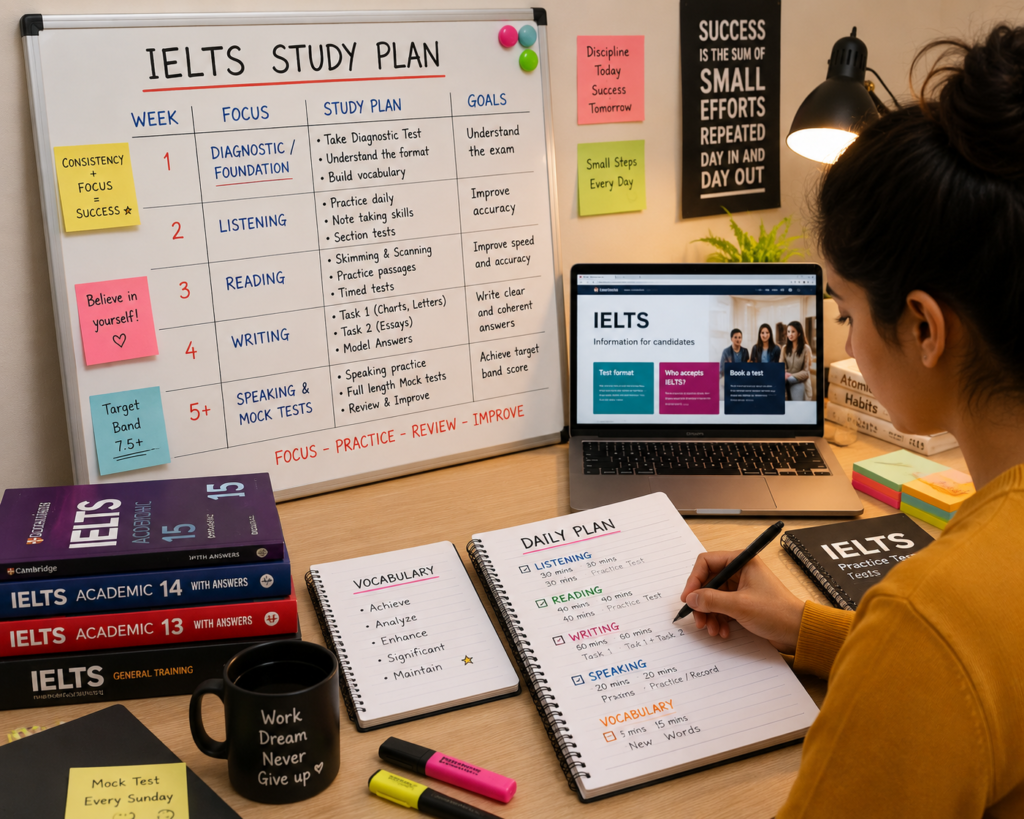
This 8-week plan is designed for students starting from a baseline of Band 5.5 to 6.0 and targeting Band 6.5 to 7.0. Adjust the pace based on your diagnostic test results and target score.
Weeks 1 and 2: Understand and Diagnose
Take a full-length diagnostic test. Study the official IELTS band descriptors for all four sections. Identify your two weakest skills and focus 60 percent of your study time on them. Begin daily reading practice with English language newspapers and academic articles.
Weeks 3 and 4: Build Section Skills
Work through one complete section per day using official Cambridge materials. Write one Writing Task 2 essay every day and review it against the band descriptors. Practice speaking answers for 20 minutes daily and record yourself at least three times this week.
Weeks 5 and 6: Timed Practice
Begin taking two full timed practice tests per week under genuine exam conditions. Review every wrong answer in detail. Track your progress in a notebook and note whether the same question types are causing repeated errors.
Weeks 7 and 8: Consolidate and Refine
Focus entirely on your weakest remaining areas. Take one full timed practice test per week. In the final week, do not start any new material. Review key vocabulary, essay structures, and Speaking Part 3 discussion techniques. Sleep early and arrive to your test day calm and prepared.
Common IELTS Mistakes That Cost Students Band Points in 2026
Using Memorized Essay Templates
Examiners in 2026 are specifically trained to identify memorized essay templates and pre-prepared content. Using templates consistently lowers your Task Response score because they prevent you from genuinely addressing the specific question prompt. Learn essay structures but always adapt your content completely to the actual question given.
Taking the Wrong IELTS Version
Submitting a General Training IELTS score to a university that requires Academic is an immediate disqualifier. Double check which version is required for every program on your list before booking your test.
Ignoring Individual Section Score Requirements
Many students focus only on their overall band score and are surprised when a single skill score below the required minimum disqualifies their application. A student with an overall Band 7.0 can still be rejected if their Writing score is 5.5 when a minimum of 6.0 in each skill is required. Check both overall and sectional requirements for every university.
Starting Preparation Too Late
IELTS preparation cannot be rushed. Students who begin preparing two or three weeks before their test consistently underperform relative to their actual English ability. Allow a minimum of 8 to 12 weeks of consistent preparation before your test date, especially if you are aiming for Band 7.0 or above.
Practicing Without Reviewing Mistakes
Taking practice test after practice test without carefully reviewing wrong answers is one of the most common and most wasteful preparation approaches. The learning value of any practice test comes almost entirely from the review process, not the practice itself. After every practice session, spend as much time reviewing as you spent taking the test.
Frequently Asked Questions: IELTS Preparation 2026
Most students require 8 to 12 weeks of consistent daily preparation to improve by one full band. Students starting from Band 5.0 and targeting Band 7.0 may need 16 to 20 weeks of structured study. The key variable is not time but consistency and quality of practice.
There is no limit to the number of times you can take IELTS. If your score is lower than expected, you can retake the full test or, if you scored well in some sections, use the One Skill Retake option to retake only the section where you fell short.
IELTS scores are valid for two years from the test date. Universities, employers, and immigration authorities generally do not accept IELTS scores older than two years. Plan your test date accordingly to ensure your score is valid for all your application deadlines.
The official IELTS website at ielts.org offers the most accurate and current free preparation materials, including sample tests, preparation guides, and writing resources. The British Council preparation platform is the second most reliable free resource for section-specific practice.
The Academic version uses more complex texts and requires a higher level of academic English, particularly in the Reading and Writing sections. The scoring scale is the same for both versions, but the content and difficulty of the Academic Reading and Writing sections are generally considered more demanding.
Most German universities require an overall IELTS score of 6.0 to 6.5. Some programs taught in English may require 6.5 or 7.0. Always verify the specific requirement with your target university. For more information on studying in Germany, explore our complete EduAtlasHub study abroad guides.
Final Thoughts on IELTS Preparation 2026
Effective IELTS preparation 2026 is not about studying harder it is about studying smarter. Every hour you spend understanding what examiners actually look for, practicing under real exam conditions, and reviewing your mistakes carefully is worth more than three hours of unfocused reading or random vocabulary lists.
Start early. Take a diagnostic test first. Focus on your weakest section. Use official materials. Write every day. Record your speaking. Review every mistake. Follow this approach consistently for 8 to 12 weeks and your target band score is genuinely achievable.
Once your IELTS score is ready, the next step is building your university application. If you need support with your Statement of Purpose, application essays, or choosing the right universities, explore our Dream Admit Store for complete study abroad application resources built for international students in 2026.
Your IELTS score is not a measure of your intelligence. It is a measure of how well you prepared. Prepare well.
Disclaimer: IELTS requirements vary by university, country, and program. Always verify score requirements directly with your target institution. For official IELTS information, visit ielts.org.