🏠 Home
Universities
🎓 All Universities 💰 Budget Predictor
More
📝 Exams 🏆 Scholarships 📰 Blogs ✍️ Application Mentorship 🛍️ Dream Admit Store 🛒 Cart 👥 About Us 📞 Contact
Account
🔐 Sign In ✨ Sign Up Free

US Student Visa 2027: Requirements, F-1 Visa Process, Fees & Interview Tips

Over a million international students are sitting in US classrooms right now, and every single one of them cleared the same five-step F-1 visa process you’re about to start. Most rejections come down to a missed step or an unconvincing interview, not bad luck or bad paperwork. Here’s exactly what the US student visa 2027 process involves, including the parts most guides leave out.

Preparing for your US Student Visa 2027? Know every step before you apply.

Who needs an F-1 visa?

Any student admitted to a full-time academic program at a school certified by the Student and Exchange Visitor Program (SEVP) needs an F-1. This covers undergraduate degrees, master’s programs, PhDs, and most language-training courses. It does not cover part-time study, most short courses under 18 hours a week, or programs at schools without SEVP certification, so confirm your school’s status through the Study in the States school search before anything else. Once you’ve shortlisted a few SEVP-certified options, compare their programs and estimated costs on EduAtlasHub.

Preparing your documents carefully is the first step toward your US study dream.

Every F-1 application follows the same sequence, whether you’re headed to a two-year college or a PhD program. Miss the order and you’ll hit delays, so work through these in sequence rather than jumping ahead.

Step 1: Get your I-20 from your school

Once you accept an offer, your school’s international office issues Form I-20, the Certificate of Eligibility for Nonimmigrant Student Status. It carries your SEVIS ID (starting with N), your program details, and your estimated costs for the year. Every document you file afterward has to match this one exactly, so check it carefully the moment it arrives. A misspelled name or wrong program date here creates problems all the way through to your interview.

Step 2: Pay the SEVIS I-901 fee

Before you can book an interview, you pay the SEVIS fee at fmjfee.com. As of mid-2026, this fee is $350 for F-1 students. Pay it using your SEVIS ID and school information exactly as they appear on your I-20, and keep the receipt. You’ll be asked for it at the embassy, and a lost receipt means a delay you don’t want this close to your intake date.

Step 3: Complete the DS-160

The DS-160 is the standard online application for any US non-immigrant visa. Fill it in carefully. Your program name, dates, and school details need to match your I-20 exactly. Small mismatches are one of the most common reasons interviews go badly. Once submitted, save the confirmation page with its barcode. You’ll need to print it for your appointment.

Step 4: Pay the visa application fee

The Machine Readable Visa fee is $185, paid separately from the SEVIS fee. Combined, budget around $535 in government fees alone before you’ve paid for anything else like flights or the SEVP institution’s own charges.

There’s also a $250 “Visa Integrity Fee” that US law created in 2025. As of mid-2026 it hasn’t started being collected, since the rules for how to implement it haven’t been published yet. This is worth watching closely if you’re applying closer to your 2027 intake, since it could change before then. Check the current fee schedule on travel.state.gov directly rather than relying on a fixed number from any guide, this one included.

Step 5: Attend your visa interview

Book your appointment as early as your embassy allows, ideally as soon as your DS-160 and SEVIS payment are done. You can apply up to 120 days before your program start date, though you can’t actually enter the US more than 30 days before classes begin.

Bring to the interview:

  • Valid passport (with at least six months’ validity beyond your intended stay)
  • I-20 and SEVIS receipt
  • DS-160 confirmation page
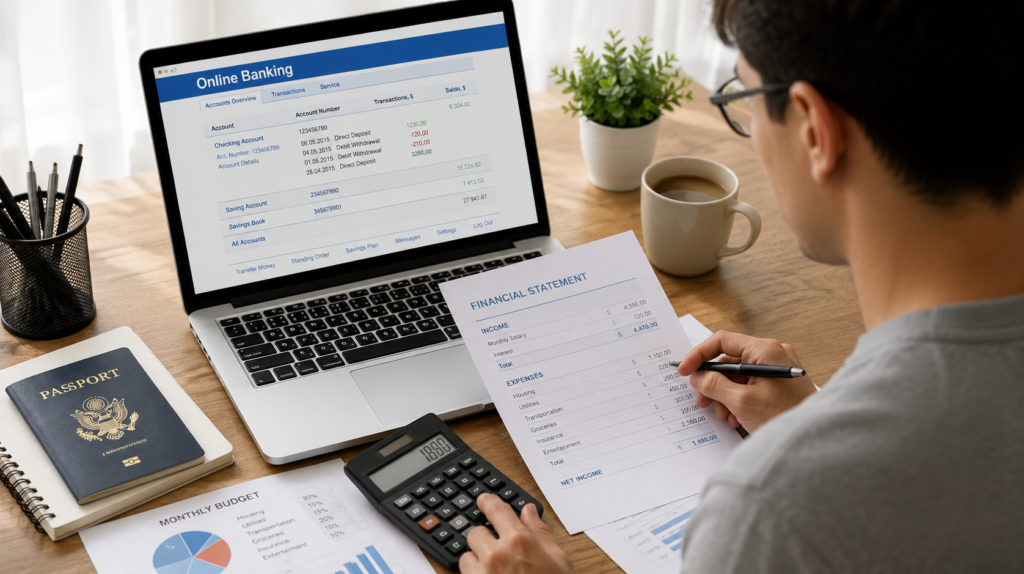
  • Proof of funds: personal or sponsor bank statements from the last 3–6 months, covering tuition and living costs
  • Academic transcripts and test scores

The interview itself is short, usually a few minutes. The consular officer is checking two things: that you have a genuine academic plan, and that you intend to return home once your program ends. Answer directly, know your program and school details cold, and don’t over-explain.

Why F-1 applications actually get refused?

Understanding the common mistakes that can turn an F-1 visa application into a refusal.

Most guides list documents and stop there. The real reason applications fail is Section 214(b) of the Immigration and Nationality Act. The officer isn’t convinced you intend to return home after your program. It’s rarely about missing paperwork. It’s about the story your paperwork and your answers tell together. A few patterns commonly trigger a 214(b) refusal.

Vague answers about your program or career plan

If you can’t explain why this specific course, at this specific school, fits your background, that reads as uncertainty rather than a real plan. Name your program, your reason for choosing it, and what comes after it in one breath.

Financial proof that doesn’t match your story

A sudden large deposit right before the interview looks staged, even when the money is entirely legitimate. Funds that build up steadily over several months look real and rarely raise a flag.

Weak or undemonstrated ties to your home country

Family, a job offer waiting for you, property, or a clearly defined return plan all help. You don’t need to over-explain this. You do need something concrete to point to if asked directly.

Inconsistent details across your forms and answers

Even small mismatches, like a program name typed slightly differently on two forms or a date that doesn’t line up, create doubt. The officer has only a few minutes to decide.
None of this means lying or rehearsing a script. Your actual plan needs to be clear enough that you can state it in one or two sentences without hesitating, because that’s roughly all the time you’ll get.

What changed for 2026 intakes, and why it still matters for 2027

A few rule changes are worth understanding before you apply, since they carry into your 2027 timeline even though they took effect in 2026.

What changed in 2026 could shape how you prepare for your 2027 F-1 visa.

From September 2026, F-1 status moved to a fixed-admission model. The date printed on your Form I-94 now controls exactly how long you’re authorized to stay in the US, replacing the older, more open-ended “duration of status” approach. This doesn’t mean every F-1 student automatically gets a fixed number of years; the exact period depends on your program and circumstances, so check current DHS guidance and ask your school’s Designated School Official (DSO) how it applies to you specifically.

English-language training programs are now generally capped at 24 months in total, including breaks and vacations. If you’ve previously studied English or are planning to combine different programs, ask your DSO how your time will be counted before you build your academic timeline around it.

Working while on an F-1 visa

F-1 students can work up to 20 hours a week on campus during term time, and full-time during official school breaks. Off-campus work needs separate authorization: Curricular Practical Training (CPT), which must be approved by your DSO on your I-20 before you begin, or Optional Practical Training (OPT), which requires both a DSO recommendation and separate USCIS approval. Working off-campus without this authorization, even informally, is treated as a status violation.

F-1 students can work while studying—but only under specific rules and authorization.

Country-specific processing realities

Interview wait times and 214(b) refusal rates vary significantly by country and even by which embassy or consulate you’re assigned to, not just by season. If your home country has a high-demand consulate, book your interview slot the moment your I-20 and SEVIS payment are ready rather than waiting for what feels like a quieter time, since slots fill up fastest exactly when everyone else has the same idea.

Visa processing can vary by country, so where you apply can make a difference.

Dual nationals should also confirm which passport their assigned embassy expects them to apply under, since current visa-issuance restrictions in 2026 apply differently depending on the passport used and the applicant’s nationality. Admission to a school and payment of every fee does not override an active issuance suspension for a given nationality, so check the Department of State’s current visa news for your country before you assume the standard process applies to you.

How long does the whole process take?

Processing time depends heavily on your country and the time of year, sometimes more than on anything in your own application. Peak intake seasons, particularly the run-up to a fall semester start, mean longer waits for interview slots at almost every embassy. Apply the moment your I-20 is in hand rather than waiting until closer to your program start date, since the 120-day window exists precisely because processing isn’t instant anywhere.

Frequently Asked Questions (FAQ)

How much does a US student visa cost in total?

Budget roughly $535: $185 for the MRV visa fee and $350 for the SEVIS I-901 fee. This doesn’t include the potential $250 Visa Integrity Fee, which wasn’t yet being collected as of mid-2026, or any fees your school itself charges.

Can I apply for my F-1 visa before I have an admission letter?

No. You need your I-20 from an SEVP-certified school first, and that only comes after you formally accept an offer.

How early can I apply for a 2027 intake?

Up to 120 days before the program start date listed on your I-20, though you still can’t enter the US more than 30 days before classes begin.

What’s the difference between the SEVIS fee and the visa fee?

The SEVIS fee ($350) funds the system that tracks international students and is paid before you book your interview. The MRV fee ($185) is the actual visa application fee, paid separately at a different stage.

What’s the single biggest reason F-1 applications get rejected?

Section 214(b), meaning the officer wasn’t convinced you intend to return home after your studies. It’s a judgment call based on your whole application and interview, not a checklist of missing documents.

Rules and fees are current as of mid-2026 and may change before your 2027 application. Always confirm the latest figures at travel.state.gov before you pay anything, and check with your school’s international office for the most current guidance specific to your situation.

Ready to shortlist schools? Compare universities with confirmed SEVP certification and estimated program costs side by side on EduAtlasHub.
Germany Student Visa 2026: Complete Guide for International Students

Your admission letter finally arrived. After months of applications, anxious refreshes, and careful planning, you got in. Screenshots went out. Family celebrations began. Then, twenty minutes later, a thought quietly appeared: Now what about the Germany student visa 2026?

That moment is more universal than most students realize. The Germany student visa 2026 process catches students off guard not because it is impossible, but because everything appears at once forms, appointments, finances, documents, and contradicting advice from every direction.

This complete guide brings the entire Germany student visa 2026 process together clearly and honestly. Stop jumping between fifteen browser tabs and start moving forward with real confidence.

“The Germany student visa 2026 process is not the destination. It is simply the bridge between where you are today and where you want to be tomorrow.”

Germany Student Visa 2026 At a Glance

  • Visa Type: National Student Visa (Nationales Visum)
  • Who Can Apply: International students with university admission
  • Processing Time: Several weeks to a few months (varies by country)
  • Financial Proof: Blocked account or accepted alternative
  • Work Rights: Part-time opportunities typically available
  • Key Requirement: Official university admission letter

Why Students Apply for the Germany Student Visa 2026

Germany has become one of the world’s most competitive study abroad destinations, and the reasons extend well beyond affordable tuition. Students choosing the student visa route are making a strategic long-term decision not just a short-term academic one.

Public universities in Germany deliver world-class education at costs that are significantly more accessible compared with many English-speaking destinations. Germany holds particular strength in engineering, technology, research, medicine, and business. Universities maintain deep relationships with industry, giving students access to internships, practical projects, and career networks that become genuinely useful after graduation. If you are still exploring your options, you can browse top universities in Germany to find the right fit for your academic goals.

Beyond academics, Germany offers excellent public transportation, student discounts across most services, safe multicultural city environments, and easy access to explore the rest of Europe. The DAAD (German Academic Exchange Service) is an excellent official resource for scholarships, university listings, and study program information.

International students on a German university campus 2026

Which Germany Student Visa 2026 Category Do You Need?

One of the most common early mistakes is assuming all student visas are identical. The correct student visa category depends directly on your current academic situation.

National Student Visa The Most Common Route

This is the primary Germany student visa 2026 category for most international students. If you have already received official admission from a German university and your program extends beyond a short stay, this is almost certainly what you need.

Student Applicant Visa

This category exists for students still completing applications or fulfilling entrance requirements. It provides flexibility while final admission decisions are still pending.

Language Course Visa

Students planning to attend German language preparation courses before beginning their main degree may require a separate category. Check directly with the German embassy or consulate in your country.

💡 Practical tip: When in doubt about which Germany student visa 2026 category applies to your situation, contact the German embassy or consulate in your home country directly.

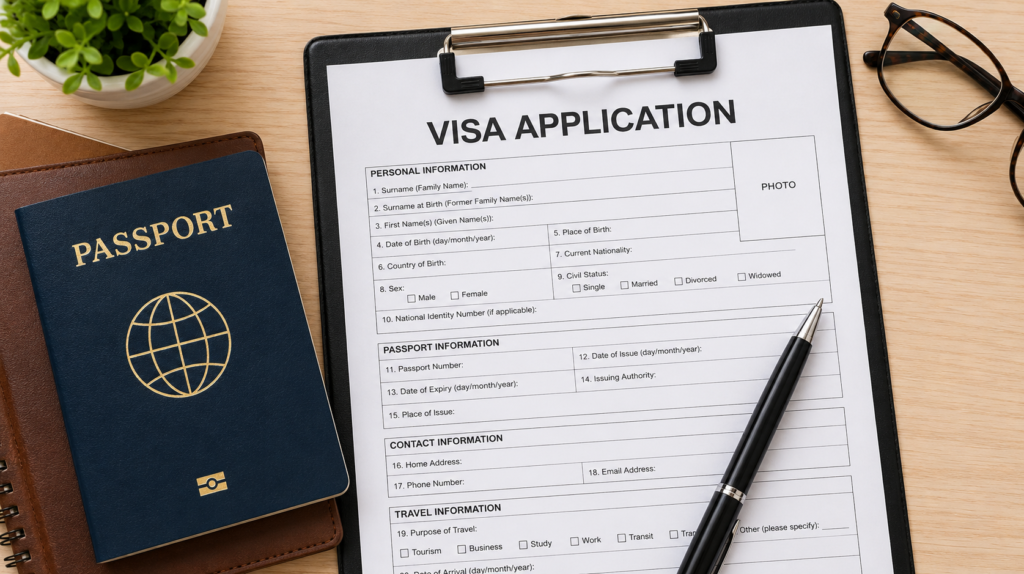
Germany student visa 2026 application form with passport on desk

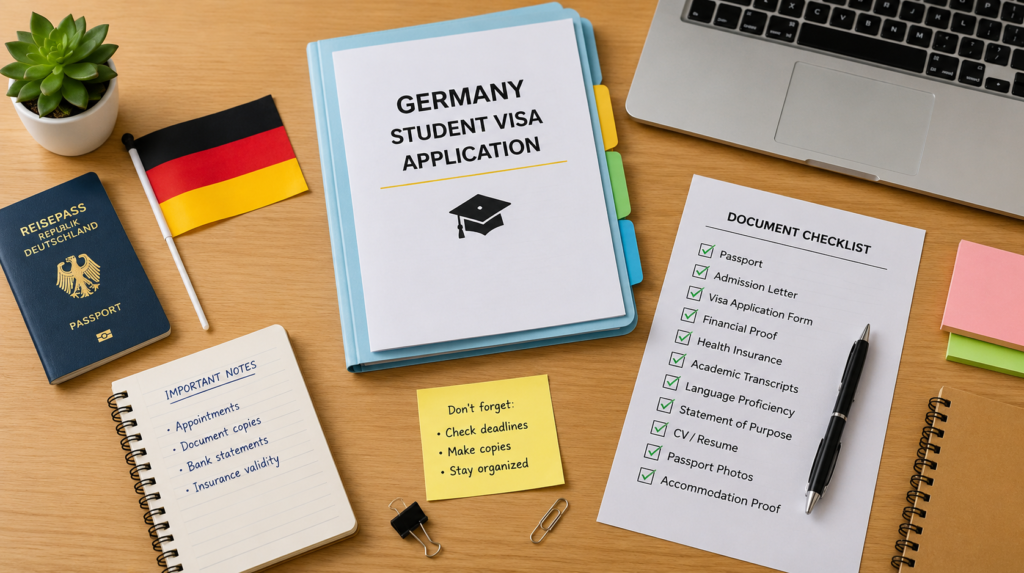
Germany Student Visa 2026 Complete Documents Checklist

Documentation is where most delays actually originate during the visa application process. Students consistently underestimate how long collecting documents realistically takes.

  • ✅ Valid passport
  • ✅ Completed visa application form
  • ✅ Recent biometric photographs
  • ✅ Official university admission letter
  • ✅ Educational certificates
  • ✅ Academic transcripts
  • ✅ Proof of previous qualifications
  • ✅ Health insurance documentation
  • ✅ Proof of financial resources (blocked account)
  • ✅ Accommodation information (if available)
  • ✅ Supporting identity records
  • ✅ Any additional university-specific requirements

Create both digital and physical copies of every document as you collect them. If your application also requires a Statement of Purpose or motivation letter, our essay help service can guide you through writing one that stands out.

⚠️ Do not wait: Students who start collecting documents two to three weeks before their appointment consistently experience the most stress. Begin immediately after receiving your admission letter. Many German universities also process international applications through uni-assist check whether your university requires this before submitting.

Germany Student Visa 2026: The Blocked Account Explained

Search any student visa resource and one phrase appears repeatedly: blocked account. The concept is actually straightforward once you understand what it is and why it exists.

German authorities require proof that international students can financially support themselves during their studies. A blocked account called a Sperrkonto in German serves as that financial proof. Students deposit a specified amount into a designated account before arriving in Germany. After arrival, the account releases a limited monthly amount for living expenses.

⚠️ Verify the current amount: The required figure for the blocked account is reviewed and updated periodically by German authorities. Always confirm the current requirement through the official German Federal Foreign Office or the embassy in your home country.

Common providers for opening a blocked account include Fintiba, Expatrio, and Deutsche Bank, among others. Research your options early account approval can take significantly longer than students expect. Students who treat the blocked account as a last-minute task consistently report the most avoidable stress during their Germany student visa 2026 journey.

 Student setting up blocked account for Germany student visa 2026

Germany Student Visa 2026 Application Step by Step

Breaking the visa application process into sequential steps makes it manageable. Each step below has one clear focus.

Step 1 Receive and Review Your Admission Letter

Everything begins here. Read your offer carefully, note all deadlines, and identify any additional documents requested by your institution. This letter is the foundation of your entire Germany student visa 2026 application.

Step 2 Begin Financial Preparation Immediately

Start the blocked account process in parallel with document gathering. Do not wait until your appointment is approaching. Financial setup takes time, and delays here create delays everywhere else.

Step 3 Collect and Organize All Required Documents

Request documents from your university, bank, and government offices early. Create digital backups. Label physical folders clearly.

Step 4 Book Your Visa Appointment Early

Appointment slots at German embassies and consulates fill very quickly during peak admission seasons. Book as early as possible.

Step 5 Attend Your Visa Appointment

Arrive with documents organized neatly. Answer questions honestly and calmly. Preparation is the most effective remedy for appointment anxiety.

Step 6 Wait for Processing

Processing time varies depending on your country, the season, and application volume. Monitor your email and keep your phone accessible.

Step 7 Prepare for Your Move to Germany

Once approved, the exciting phase begins. Start accommodation searches, join student community groups, and begin packing. The hard part is behind you.

Germany Student Visa 2026 Processing Time

Processing time is consistently one of the most searched questions among students preparing their Germany student visa 2026 application. The honest answer is that there is no single universal timeline it depends on your country of application, embassy workload, time of year, and document verification speed.

During peak admission seasons, processing demand increases significantly and timelines can extend beyond what students initially expect. The safest strategy is simple receive your admission, begin preparation immediately, book your appointment early, and submit everything well before your university’s enrollment deadline.

📎 For the most current and country-specific processing time guidance, refer to the official source: German Federal Foreign Office Student Visa FAQ

Working in Germany on a Student Visa 2026

Germany remains attractive for students pursuing a student visa because international students typically have genuine opportunities to work during their studies.

Students already studying in Germany frequently describe their first part-time role as one of the experiences that helped them adapt most quickly. Working alongside local students and professionals improved language skills, built professional networks, and gave a sense of connection to life in Germany beyond campus walls.

Common opportunities students explore include:

  • University assistant and research positions
  • Internships connected to their field of study
  • Café, restaurant, and retail roles
  • Customer support positions
  • Campus student services jobs
  • Freelance work depending on individual skills

⚠️ Verify current regulations: Work allowances for students holding a Germany student visa 2026 are subject to specific rules and hour limitations. Always confirm current working conditions through your university’s international student office before accepting any employment.

 International student working part time in Germany on student visa 2026

Why Germany Student Visa 2026 Applications Get Rejected

Understanding why applications fail is one of the most genuinely useful things you can do before submitting your Germany student visa 2026 application. Most rejections are caused by smaller, avoidable problems that accumulate during the review process.

Incomplete Documentation

Missing even a single required document can delay or derail an application even when everything else is in order.

Weak Financial Evidence

If your blocked account or supporting financial documents appear insufficient or unclear, the reviewing officer has reason to question whether you can realistically support yourself during studies.

Contradicting Information

A date that differs between two documents, a name spelled inconsistently, or figures that do not match across forms these small inconsistencies raise questions that are entirely avoidable.

Unclear Study Plans

An application that cannot clearly explain why the student chose a particular field, how it connects to their background, and what they intend to do after graduation presents a weaker overall case.

Applying Too Late

Rushed applications are more likely to contain errors, and late submissions reduce the buffer available if additional documents are requested during processing.

✅ Tip: After completing your full application, ask someone else a parent, trusted friend, or academic advisor to review every document independently. A fresh pair of eyes catches inconsistencies and gaps you will almost certainly overlook.

 Student reviewing Germany student visa 2026 application to avoid rejection

Practical Tips After Getting Your Germany Student Visa 2026

Join student communities online before you arrive. Facebook groups, Discord servers, and WhatsApp communities organized around your university or city connect you with students who are already there or moving at the same time.

Research accommodation early and seriously. Student housing in major German cities fills quickly, and waiting until your visa is approved to begin searching can leave you in a genuinely difficult position.

Learn a few German phrases before arriving. Basic conversational German makes administrative tasks and daily interactions noticeably easier in the first few weeks, even in cities where English is widely spoken.

Keep digital copies of every important document stored in a cloud service you can access from any device. If you need additional support with your study abroad preparation, explore our Dream Admit Store for resources built specifically for international students.

 International students enjoying student life in Germany after Germany student visa 2026 approval

Frequently Asked Questions Germany Student Visa 2026

Is the Germany student visa 2026 process difficult?

The process follows a clear structure. Most students find the paperwork and waiting more stressful than the process itself. Starting early and staying organized makes an enormous difference.

Can students stay in Germany after graduation?

Germany offers post-study pathways for graduates who wish to remain and seek employment. Specific eligibility conditions apply verify current regulations through official immigration sources.

Is IELTS mandatory for the Germany student visa 2026?

Language requirements depend on your university and program. Some courses are taught in English, some require German proficiency, and some accept alternatives. Check directly with your institution.

How expensive is living in Germany as a student?

Living costs vary considerably between cities. Munich and Frankfurt tend to be pricier. Smaller university cities can be significantly more affordable.

What happens if my Germany student visa 2026 is delayed?

Contact your university’s international students office as early as possible. Universities are familiar with visa delays and typically have experience helping students navigate the situation.

Can I travel across Europe while studying in Germany?

Many students explore Europe during their studies. Germany’s Schengen Area membership provides access to many neighboring countries. Travel options depend on your specific visa conditions.

Can I change universities after arriving in Germany?

This may be possible, but immigration regulations and university transfer policies apply. Always verify current rules through your university’s international office.

Can I apply before confirming accommodation?

Requirements vary by embassy. Some students provide a temporary address or student housing confirmation. Check current requirements for your specific country of application.

Final Thoughts

There is a point during every study abroad journey where everything feels overwhelming simultaneously. Documents pile up. Deadlines appear suddenly. Your search history becomes chaotic. That feeling is entirely normal every international student who has made this journey experienced it.

The process asks you to become a researcher, planner, finance manager, and document organizer all at once for weeks or months. It is genuinely demanding. But it is also finite.

Months from now, you may look back at this process from a classroom in Germany, surrounded by new friends and opportunities you have not yet imagined. This visa was not the destination. It was the bridge.

Take one step at a time. You are probably much closer than you think.

Disclaimer: This article is for informational purposes only. Always verify requirements with official German authorities. Official Source: German Federal Foreign Office